Cloud engineering / Azure Static Delivery
Azure Static Delivery
Small artifact. Traceable release.
A rebuilt static application with versioned hosting configuration, automated local checks and a manually dispatched Azure deployment workflow. The design makes the source artifact inspectable and keeps deployment credentials outside browser-delivered files.
Azure Static Delivery / Architecture
01 / The question
What makes a small deployment reproducible?
A deployment screenshot records a moment; a reproducible project also needs its source, workflow and hosting settings. This update supplies a minimal static implementation and separates local artifact validation from the checks that must happen after Azure deployment.
My contributionRebuilt the static source, added hosting configuration and an endpoint verifier, prepared a repository-root GitHub Actions workflow and corrected the deployment narrative.
02 / System walkthrough
From input to evidence.
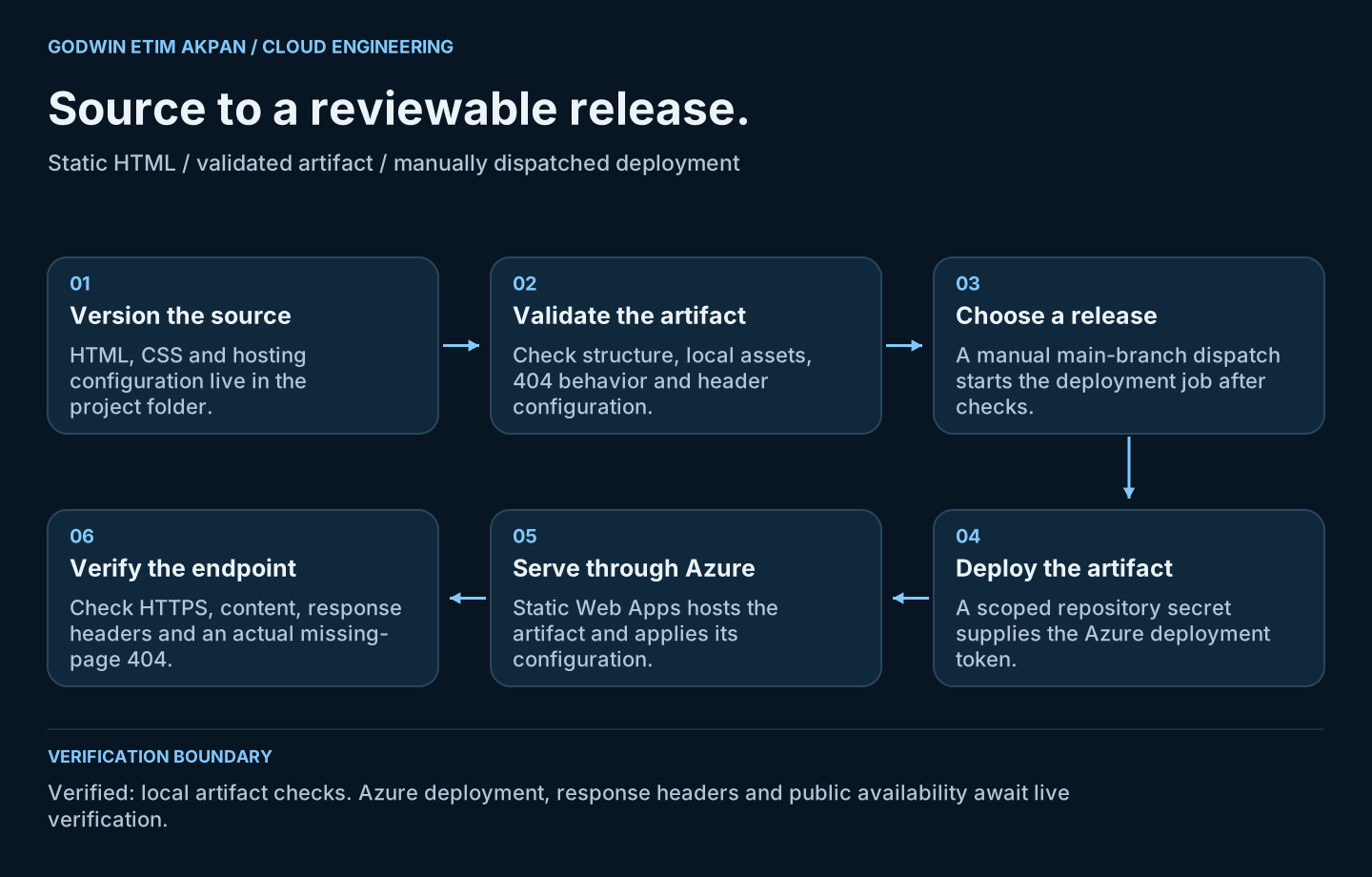
The stages of the implementation and its verification boundary.
- 01
Version the artifact
Keep the HTML, external CSS, 404 page and Static Web Apps configuration together.
- 02
Validate locally
Check document structure, local links, security-header configuration and the custom 404 mapping.
- 03
Choose deployment
Automatic push and pull-request jobs validate only. A main-branch manual dispatch enables the deployment job.
- 04
Verify the served endpoint
After deployment, test HTTPS, expected content, actual headers and a random missing-page response.
03 / Engineering decisions
Why the implementation matters.
Static means static
The current application is HTML and CSS. It is not presented as an ASP.NET server running inside static hosting.
Separate validation from deployment
The deployment token is accessed only by the manual deployment job after validation; the workflow uses read-only repository permission and pinned action commits.
Configuration is not a runtime observation
Header and 404 settings are checked locally. A separate endpoint script verifies their real behavior once hosted.
04 / Results & interpretation
What the checks establish.
The rebuilt static artifact passed local checks. Cloud deployment and endpoint behavior are pending separate verification.
Artifact validation
5 passedLocal checks cover documents, asset references, header configuration, 404 mapping and simple client-secret indicators.
Publishable source
RebuiltThe previously missing static application and workflow are included with commands for local preview and release.
Live Azure endpoint
UnverifiedNo active deployment badge or placeholder demo URL is presented. Historical screenshots are retained with their limited scope.
05 / Scope & limitations
Scope & limitations.
- Deployment is preparedNo new GitHub Actions run or Azure deployment was executed for this update; no live availability is asserted.
- Historical evidence has boundariesThe older local .NET screenshot and Azure resource-deployment screenshot do not establish that the rebuilt static artifact was served.
- Controls are not certificationA header configuration and CI workflow do not establish a secure application, a penetration test or compliance with a security framework.
06 / Next iteration
Where I would take it next.
The next technical priorities for this project.
Deploy in an approved Azure resource
Configure the dedicated deployment secret and optional environment reviewers, dispatch the workflow and retain its run URL.
Verify the public response
Run the endpoint checker and save its report before publishing a live-demo link.
07 / Code & reproducibility
Explore the implementation.
Source, execution commands, verification reports and architecture are documented in the linked GitHub project.
- static/ — inspectable HTML, CSS, 404 and hosting settings
- validate_static.py — locally executed artifact checks
- Repository root .github/workflows/azure-portfolio-lab.yml — prepared validation and manual deployment
- verify_endpoint.py — post-deployment HTTPS, headers and missing-page checks
Original architecture diagrams describe the implementation and its verification boundary. They are explanatory diagrams, not screenshots of a deployed system.